Assessment of Student Learning
Eastern Arizona College is committed to a culture of continuous improvement through the systematic assessment of student learning. The College identifies expected learning outcomes, provides meaningful opportunities for students to achieve those outcomes, evaluates student achievement using established assessment methods, analyzes the resulting evidence, and uses findings to improve curriculum, instruction, programs, and student success.
Learning outcomes assessment is a shared responsibility among faculty and others who work together to create outcomes, assessment plans, and projects across delivery modes and locations. Faculty and staff identify learning outcomes, review evidence of student performance, discuss what the results show, and use those findings to strengthen courses, programs, services, and student support.
Faculty identify what students should know or be able to do.
Faculty prepare assessment plans to review their programs and gather meaningful evidence of student learning, including assignments, projects, examinations, demonstrations, performances, and other student work.
Faculty and staff identify strengths, concerns, and patterns in student performance.
Faculty use assessment findings to improve curriculum, instruction, assignments, services, and student support.
Faculty continue to examine student learning to determine whether changes are having the intended effect.
Ensuring Quality of Instruction
Eastern Arizona College is committed to providing meaningful, consistent, and high-quality learning experiences for every student, regardless of program, location, or method of instruction.
This commitment begins with clearly defined learning outcomes that describe what students should know and be able to do upon completing a course or academic program. Faculty regularly assess student learning and use the results to strengthen curriculum, teaching practices, course delivery, and academic support.
EAC’s approach includes:
- Clearly defined learning outcomes at the course and program levels
- Regular assessment of student learning and achievement
- Faculty-led review and interpretation of assessment results
- Evidence-based improvements to courses, programs, and instructional practices
- Consistent academic expectations across all methods of course delivery
Through this ongoing process, EAC works to ensure that academic programs remain relevant, instruction supports student success, and assessment leads to meaningful improvements in the student learning experience.

Assessment Methodology
Core Components
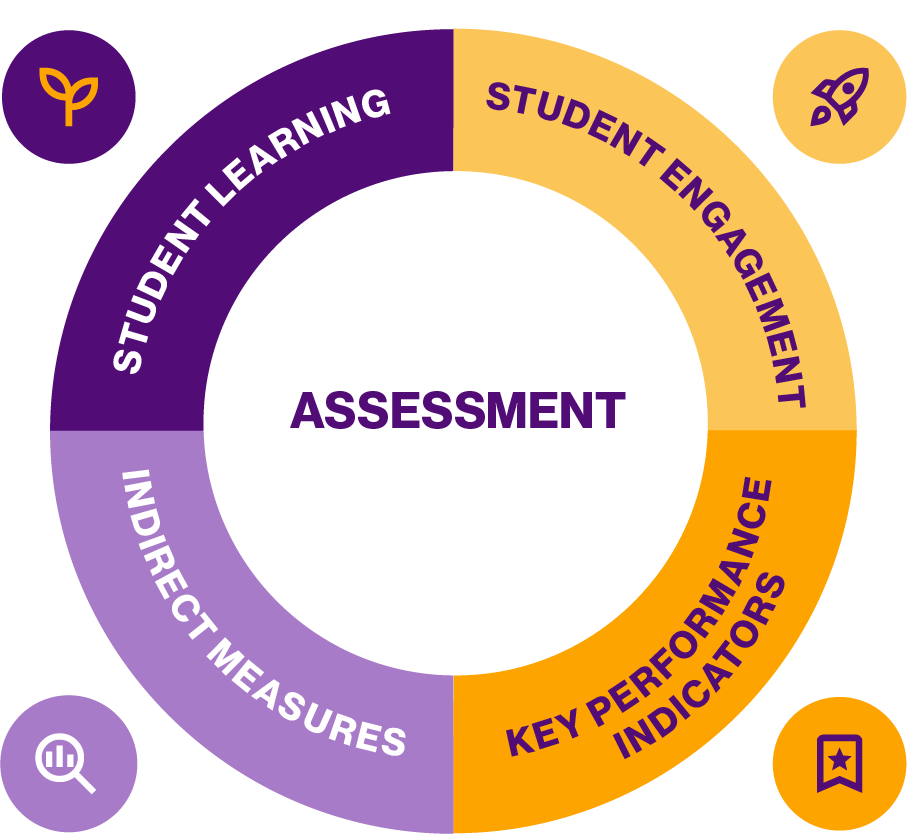
To ensure a balanced and accurate assessment, four core components are researched, analyzed, tested, and presented:
- Student Learning
- Student Engagement
- Indirect Measures
- Key Performance Indicators
These four areas reveal the full impact and extent of student learning at Eastern Arizona College. From this, decisions and recommendations can be made in confidence by our Assessment team to improve EA’s offerings.
-
Overview
Student learning is assessed, measured, and reported annually by EAC faculty, covering four key areas:
- Essential Learning Outcomes
- Program Assessment Plans
- Course Assessment Plans
- Co-curricular Activities
-
Essential Learning Outcomes Assessment
Essential Learning Outcomes (ELOs), also known as general learning outcomes, are reported annually.
Students earning degrees at Eastern Arizona College fulfill general education requirements by demonstrating competency in the following: communication, creativity, critical thinking, diverse and global perspectives, and technology, information literacy, and quantitative reasoning. These outcomes state the expected knowledge, skills, attitudes, competencies, and habits of mind that students will be able to demonstrate upon completion of a degree.
- Communication: Students, using reading, writing and/or speaking skills, discover, organize, and communicate information, ideas, and arguments in a clear and effective manner appropriate to the audience and purpose.
- Creativity: Students demonstrate the ability to: analyze, evaluate, and reflect on subjective experiences; propose innovative solutions to technical, scientific, social, or individual problems; and/or produce artifacts of self-expression.
- Critical Thinking: Students use intellectual skills and habits to become independent and dynamic thinkers who are capable of innovation, adaptation, and problem-solving.
- Diverse and Global Perspectives: Students demonstrate an understanding and application of the interdependent roles of historical, cultural, socio-economic, geographic, and ecological influences on the diversity of human experience.
- Technology and Information Literacy: Students recognize that information is needed, and they use both traditional and modern technologies to effectively locate, evaluate, manage, and apply the needed information.
- Quantitative Reasoning: Students demonstrate skills in analyzing quantitative information, representing quantitative information in appropriate forms, completing calculations to answer meaningful questions, making judgments based on quantitative data and communicating the results of that work for various purposes and audiences.
-
Program Outcomes Assessment
Program-level assessments inform ELOs and are reported on by their respective dean, through program portfolios, annually.
Every academic year, each program submits an assessment plan. This plan focuses on an outcome taught across courses or on an outcome specific to a course. Programs are driven by research questions or results from the previous year.
-
Course Outcomes Assessment
Class assessments inform program and essential learning outcomes. Faculty work on at least one assessment goal each year. Results are documented and reviewed during annual employee evaluations.
-
Co-Curricular
Co-curricular activities, such as student employment, athletics, and library resources, help remove barriers that would otherwise prevent students from attending college or graduating.
Faculty and staff responsible for these activities document learning outcomes and experiences. These outcomes are then submitted as part of the program portfolio.
-
Overview
Qualitative indirect measurement data complements and enhances the quantitative data found in key performance indicators. Through behavioral observation and conceptual based analysis and categorization, deep, context-rich insights are established that inform complex decisions.
These insights are obtained through:
- Classroom Observations
- Students Surveys of Instruction
- Survey Responses
-
Classroom Observations
Classroom observations provide faculty with constructive feedback on teaching practices, student engagement, and the overall learning environment. They help recognize effective instruction and identify opportunities to strengthen teaching and student learning.
-
Students Surveys of Instruction
At the end of every course, students are invited to provide feedback about their instructional experience through the Student Survey of Instruction. Academic deans review the results to identify strengths, address concerns, and support continuous improvement in instruction and course delivery.
-
Survey Responses
-
Overview
Eastern Arizona College uses a variety of key performance indicators, data points, and institutional measures to better understand how students progress toward their educational goals. These measures help the College evaluate student success, identify trends and areas for improvement, and guide decisions related to academic programs, student support, and institutional resources.
Among the indicators regularly examined are:
- Completion Rates: The extent to which students earn a certificate, degree, or other recognized credential.
- Retention and Persistence: The extent to which students continue their education from one academic period to the next.
- Graduation Rates: The percentage of students within a defined entering group who complete a certificate or degree within a specified period.
These indicators, considered alongside other academic and institutional data, provide a broader picture of student progress and help EAC strengthen the programs, services, and learning environments that support student achievement.
-
Completion Rates
Completion refers to a student earning a recognized college credential, such as a certificate or degree. Completion measures may examine the number or percentage of students who earn a credential within a specified period.
-
Retention / Persistence
Retention refers to students continuing their education at Eastern Arizona College from one defined period to another, commonly from one fall semester to the following fall semester.
Persistence is broader and refers to students continuing their education, whether at EAC or another institution. Depending on the measure, students who earn a credential before the next measurement period may also be considered successful outcomes.
-
Graduation Rates
Graduation rates represent the percentage of students in a defined entering group, or cohort, who complete a certificate or degree at EAC within a specified period. Graduation rates are calculated using established criteria concerning which students are included, the credentials earned, and the amount of time allowed for completion.
-
Overview
Learning isn’t restricted to the four walls of the classroom. Either off or on campus, Eastern Arizona College works to provide and expand educational opportunities in
- Field Trips
- Campus Events
- Student Clubs
-
Field Trips
-
Campus Events
-
Student Clubs
Presentation of Findings
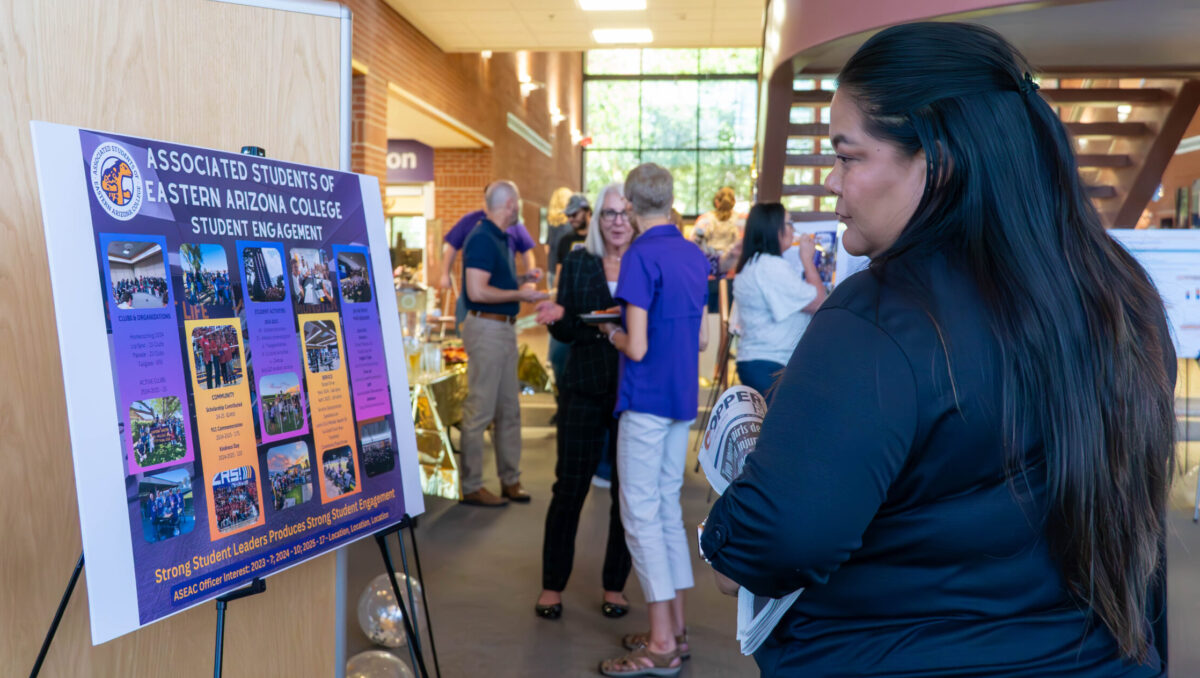
Eastern Arizona College warmly encourages the community, students, faculty, and staff to participate in the culminating assessment event: Presentation of Findings – Poster Celebration, held annually on the fourth Tuesday of April.
Promoting innovative ideas, thoughtful insights, and investment in student success, this celebration showcases the culmination of the College’s efforts for the academic year and highlights the action plans for the following year.
For more Information, contact the Assessment Coordinator:


EA lets me explore new opportunities: I’m used to living out east, so I [headed] out west. I enjoy my friends and the art department. I can see my creative skills improving because of the teachers here.
Emilie from Suwanee, GA | Studying Art